

Jan0-13
2027
Body Structure Hologram
“A new generation of structural balancing — integrating muscles, bones, joints, meridians, emotions and holograms.”Jan 0
2027
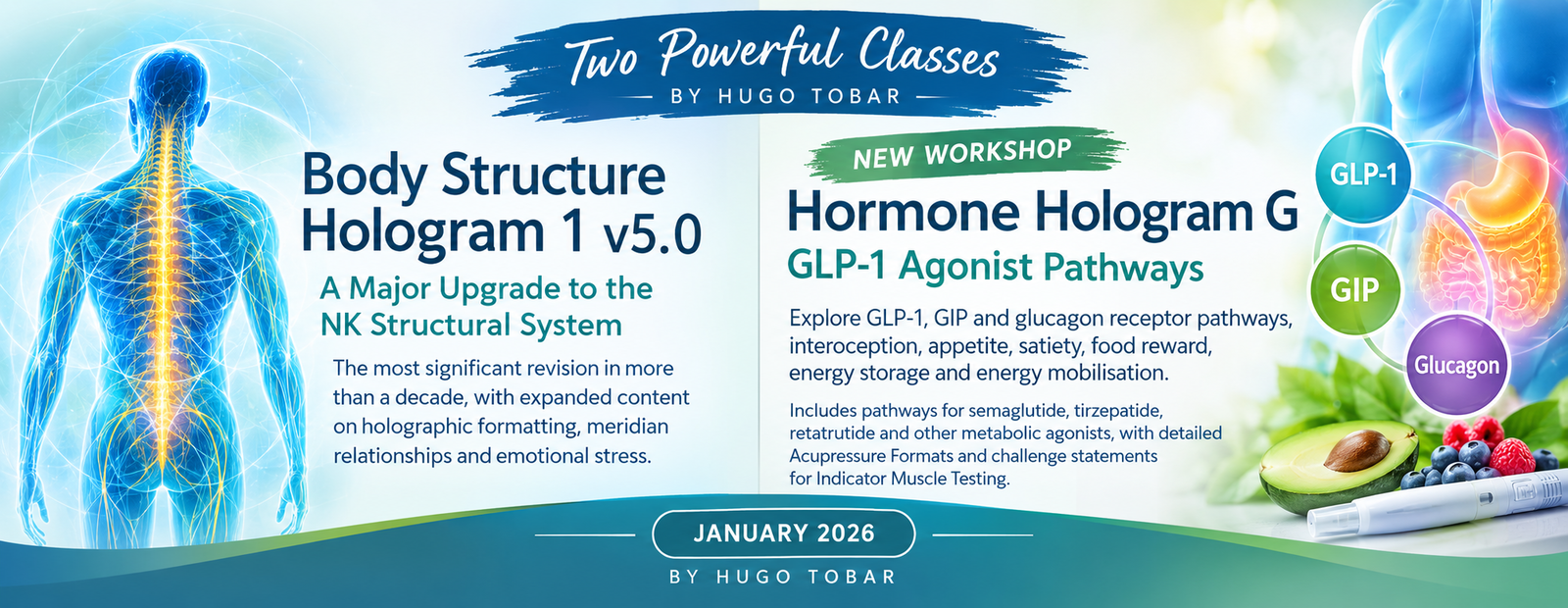
Hormone Hologram G — GLP-1 Agonist Pathways
Explore GLP-1, GIP and glucagon receptor pathways, interoception, appetite, satiety, food reward, energy storage and energy mobilisation.
Body Structure Hologram 1 v5.0 — A Major Upgrade to the NK Structural System
We are pleased to announce the release of Body Structure Hologram 1 v5.0, the most significant revision of this material in more than a decade.
The previous version, v4.3, was released in January 2015. Since returning to the structural material, Hugo has extensively reorganised and expanded the system, incorporating developments in holographic formatting, meridian relationships and emotional stress that have evolved within Neuroenergetic Kinesiology over the intervening years.
A deeper way of working with muscles and bones
One of the most important changes in v5.0 is the development of a much more comprehensive balance for each individual muscle and bone.
The muscle balances now bring together the muscle format and neurological relationships with its associated meridian, Functional Canopener Hologram, Structural Transductional Hologram (TdH) and suppressed emotional patterns. The manual connects the emotional component directly with the corresponding meridian emotional database.
The bone system has undergone an even greater expansion.
NEW — Bone–Meridian Relationships
Version 5.0 introduces meridian relationships for the bones.
The bone database can now be accessed both by bone and by meridian, creating a new bridge between the structural skeleton and the energetic relationships of the meridian system.
Individual bone balances can then incorporate the associated meridian and its emotional relationships. For example, the new pelvis and leg section identifies different meridian associations for the ilium, sacrum, coccyx, femur, patella, tibia and fibula.
NEW — Unconscious Emotions in the Bones
The new bone balances introduce formatting for unconscious emotional stress associated with the bone.
This adds another dimension to structural balancing: rather than working only with the physical structure of a bone, the practitioner can investigate whether an unconscious emotional relationship associated with its meridian is part of the balance.
Expanded Holograms
The holographic component of Body Structure Hologram has also been greatly expanded.
Version 5.0 includes:
Structural Transductional Holograms (TdH) for muscles
Structural Transductional Holograms (TdH) for bones
Functional Canopener Holograms for muscles
Functional Canopener Holograms for bones
A typical new bone balance therefore combines the specific bone format with its Canopener Hologram, TdH, unconscious emotional formatting and associated meridian emotions.
Much More Detailed Joint Balancing
Another major area of development is the joint balances.
Rather than treating broad regions of the body as a single structural balance, v5.0 provides much greater access to the individual articulations within each region.
The hand balance, for example, can differentiate the distal radioulnar articulation, radiocarpal articulation, intercarpal articulations, midcarpal joint, carpometacarpal joints, intermetacarpal articulations, metacarpophalangeal joints and individual interphalangeal articulations. The foot section is similarly expanded through the ankle, tarsal, tarsometatarsal, Lisfranc, metatarsophalangeal, subtalar and other articulations.
This allows the practitioner to be considerably more specific about the bones, muscles and ligaments belonging to the individual joint being balanced.
Upgraded Specialised Structural Balances
Several of the established Body Structure Hologram procedures have also been reviewed and upgraded, including:
Eye Muscle Balance
Middle Ear Balance
Structure Alignment Protocol
Reactive Muscle Balance
Centring Balance
More than an update
Body Structure Hologram 1 v5.0 represents an evolution in the way structural stress can be explored within Neuroenergetic Kinesiology.
The new system allows a practitioner to move from the physical structure of a muscle, bone or joint into its neurological, meridian, emotional, functional and holographic relationships — while retaining the detailed structural formatting that has always formed the foundation of Body Structure Hologram.
After more than 11 years since the previous edition, we are delighted to introduce the new Body Structure Hologram 1 v5.0.
“From structure to function — exploring the deeper relationships of muscles, bones and joints.”
New Workshop: Hormone Hologram G — GLP-1 Agonist Pathways
The use of GLP-1 receptor agonists for diabetes, weight management and metabolic regulation has expanded rapidly. Medications such as Ozempic®, Wegovy®, Mounjaro®, Zepbound®, Saxenda® and Trulicity® influence far more than appetite alone. Their effects involve the stomach, intestines, pancreas, adipose tissue, liver, kidneys, heart and multiple regions of the brain.
Hormone Hologram G — GLP-1 Agonist Pathways is a new Neuroenergetic
Kinesiology workshop designed to explore these complex metabolic pathways through Acupressure Formatting and Indicator Muscle Testing.
The workshop examines the actions of:
GLP-1 receptor agonists
GIP receptor agonists
Glucagon receptor agonists
Dual GLP-1/GIP agonists such as tirzepatide
Triple GLP-1/GIP/glucagon agonists such as retatrutide
A central focus of the workshop is interoception—how the brain interprets the internal physiological signals associated with nourishment, satiety, glucose availability, energy storage and energy mobilisation. Naturally occurring GLP-1, GIP and glucagon are released within coordinated physiological sequences. Medication-induced receptor activation may occur without all the usual sensory events, potentially creating an interoceptive mismatch between what the brain predicts and what the body is signalling. This workshop provides pathways for balancing the body’s capacity to safely interpret and integrate these altered metabolic messages.
Participants will explore receptor pathways within the stomach, small intestine, pancreas, liver, adipose tissue, bone, kidneys, heart and central nervous system. The workshop also follows signalling through the nucleus of the solitary tract, hypothalamus, parabrachial nucleus, thalamus, insula, anterior cingulate cortex and prefrontal cortex.
Challenge statements include themes such as:
“My nutritional needs are being met.”
“I can feel satisfied.”
“My body can safely access stored energy.”
“My brain accurately interprets my nutritional state.”
“I can feel rewarded without needing food.”
This workshop offers a detailed pathways-based framework for practitioners working with clients who use GLP-1, dual or triple receptor agonist medications, including those experiencing altered appetite, nausea, fullness, food aversion, metabolic changes or changes in reward-seeking behaviour.
Hormone Hologram G — GLP-1 Agonist Pathways brings together metabolic physiology, interoception and neuroenergetic balancing in a highly relevant new workshop.